 |
Wednesday, August 21, 2013
Interested In Increasing The Pollinators In Your Haskap Orchard?


Tuesday, August 13, 2013
Parisian Bee Hotels
...s'interroger sur la nécessité et le charme de nourrir les pollinisateurs indigènes


...bon ... très très bon
Tuesday, July 30, 2013
Haskap Day - U of SK 2013 (6)
 Afternoon Presentations
Bob Bors - U of SK breeding program update
James Dawson - Neutriceutical/Phytochemical discussion
Loretta Bors - Development of cookbook
Curtis Braaten - Raised bed planting
Cory Sheffield (unable to attend) - Pollination Study
Hamish Graham - Hydroplanting
Haskap Canada - Update
Open Forum
*Anyone with recipes for haskap and would like them included in the cookbook is encouraged to contact Loretta Bors (lorettaborsathotmaildotcom)or Lil Sawatzky (lilymaeatsaskteldotcom).
Friday, July 26, 2013
Haskap Day - U of SK 2013 (5)
Hardiness
Not an official stop on the tour, I recalled this plot as having a nice selection of mature haskap in previous years. Inquiring, the plants had served their purpose, been selected, and removed.

Now, thoroughly cultivated, young plants are still growing there from remnants of roots...

Wednesday, July 24, 2013
Haskap Day - U of SK 2013 (4)
Field Evaluation of Plants and Fruit
This is a mature edible blue honeysuckle berry from an edible blue honeysuckle plant that is native to Canada.

These plants (below) were collected from all across Canada...some even emerge with red leaves in the spring...does this indicate different anthocyanin composition?

If neutriceutical value is found in the skin of fruit, does that mean that odd-shaped varieties, such as this one of Japanese parentage, have a greater health value?

This is a mature edible blue honeysuckle berry from an edible blue honeysuckle plant that is native to Canada.

These plants (below) were collected from all across Canada...some even emerge with red leaves in the spring...does this indicate different anthocyanin composition?

If neutriceutical value is found in the skin of fruit, does that mean that odd-shaped varieties, such as this one of Japanese parentage, have a greater health value?

Tuesday, July 23, 2013
Haskap Day - U of SK 2013 (3)
Pruning
Pruning trials are currently under way. Three methods are being tested: bottom trimming, centre trimming, and bonsai styles, respectively...

 |

Monday, July 22, 2013
Haskap Day - U of SK 2013 (2)

In the field participants were able to see and taste the results of the U of SK's selection program, and to listen to the grounds for selection while standing in the midst of the huge number of individual genotypes that have been carefully watched and considered throughout the growing season as possible parent-stock for future vigourous, winter-hardy, and tasty varieties.
Sunday, July 21, 2013
Haskap Day - U of SK 2013 (1)
If you did not attend, we missed you! What would you have experienced if you had been there?

Morning Field Tour
Field Tour
Field Fruit Tasting
Special Observation: Hybrids, Native Canadian, Japanese, Russian Varieties
Mechanical Harvesting Demonstration
Pruning Methods
Lunch - Pizza
Afternoon Presentations
Current Research
Raised Bed Planting
Recipes/Cookbook
Pollination Study
Hydroplanting
Haskap Canada Update
Over the next several posts the highlights of these will be briefly touched upon...

Morning Field Tour
Field Tour
Field Fruit Tasting
Special Observation: Hybrids, Native Canadian, Japanese, Russian Varieties
Mechanical Harvesting Demonstration
Pruning Methods
Lunch - Pizza
Afternoon Presentations
Current Research
Raised Bed Planting
Recipes/Cookbook
Pollination Study
Hydroplanting
Haskap Canada Update
Over the next several posts the highlights of these will be briefly touched upon...
Thursday, July 11, 2013
Haskap Day 2013 - July 19, 2023
One week from tomorrow the University of Saskatchewan will host this year's Haskap Day at their Horticulture Field Lab.
Updated information will be presented concerning harvest, yields, and ages of haskap involving various varieties for machine and hand picking . There will be an explanation of the various pollinator projects that are currently under way. Marketing initiatives will be discussed. Dr. Bob Bors will update participants on new varieties and James Dawson will discuss phytonutrients. There will be tours of the haskap orchard. Lunch will be $5 per person for pizza. We hope to see you there!
Updated information will be presented concerning harvest, yields, and ages of haskap involving various varieties for machine and hand picking . There will be an explanation of the various pollinator projects that are currently under way. Marketing initiatives will be discussed. Dr. Bob Bors will update participants on new varieties and James Dawson will discuss phytonutrients. There will be tours of the haskap orchard. Lunch will be $5 per person for pizza. We hope to see you there!
Saturday, June 29, 2013
Friday, June 14, 2013
Tent Caterpillars - Northern Minnesota, Lake Manitoba Narrows
Yesterday these pics arrived from a HC member in northern Minnesota...


Also, entirely stripped of their leaves, a HC member reported an infestation in the bush along Hwy. 68 (Lake Manitoba Narrows)...that the road was a carpet of tent caterpillars.
http://gardening.wsu.edu/library/inse003/inse003.htm


Also, entirely stripped of their leaves, a HC member reported an infestation in the bush along Hwy. 68 (Lake Manitoba Narrows)...that the road was a carpet of tent caterpillars.
http://gardening.wsu.edu/library/inse003/inse003.htm
Wednesday, June 12, 2013
Tent Caterpillars And Haskap
Tent caterpillar outbreaks have recently occurred in Prince George, BC, and Prince Albert, SK. Questions about larger provincial infestations are being raised. So far they do not appear to have acquired a taste for edible blue honeysuckles. Haskap growers should monitor their orchards closely for this pest. The following PDF links are to MDSD's for BTK, which is approved for use on edible blue honeysuckles: BioProtec 3P, Dipel 2X. Please report any tent caterpillar outbreaks in your orchard to Haskap Canada.

Monday, June 10, 2013
Saturday, June 8, 2013
Haskap Day 2013


Thursday, June 6, 2013
Sanitation Protocols For Fruit Producers

With haskap berry time rapidly approaching Haskap Canada would like to remind producers of their responsibility to ensure sanitary conditions in their orchards and processing facilities. Recently, at least 30 people contracted hepatitis A after consuming a frozen berry juice blend. Improper hand sanitation on the part of food preparers/handlers is most often the cause. Hepatitis A can be passed on through feces.
If you are a large producer/processor, or are thinking of becoming one, or if you are selling to restaurants or commercial food chains, or are thinking of doing so, then you should be aware of the Canada GAP program regarding the sale of fresh fruits and vegetables. This is a food safety program for companies that produce, pack, and store fruits and vegetables meant to implement and improve effective food safety procedures.
If you are a smaller scale grower you should at least read the Canada GAP protocols and seriously consider how you can make your orchard/product safe for the public, to whom you have a responsibility. Here are some very simple items to think through:
Consider:
- Do you take sanitation in your orchard seriously?
- Do you believe yourself to be responsible if someone becomes ill after eating fruit from your orchard and its cause is traced back to you?
- Can you afford to pay damages for such a situation, especially if you have no safeguards/guidelines in place?
Implement:
- Do you wash your hands thoroughly before going to your orchard? (It sounds ridiculous to ask, but do you know how to wash you hands properly? You're never to old to learn, and hopefully humble enough to do it.)
- Do you supply sanitizing gel, soap and water with which orchard users may wash?
- Do you wash your hands after visiting the bathroom? (Many people do not.)
- Do you have adequate bathroom facilities at your orchard?
- Do you encourage visitors to your orchard to wash/sanitize their hands before entering it?
- Do you allow animals/livestock in your orchard?
- Do you restrict wildlife access to your orchard?
- Do you instruct your visitors to follow a printed protocol that includes these and other sanitation guidelines? (Such as: Do you make visitors aware that if they are infected with a communicable disease, that they can spread it to others through improper personal sanitation?)
- Do you keep a record of orchard users and their contact information?
Thursday, May 30, 2013
In An Effort To Save Pollinators In Europe...
Use of neonicatinoid pesticides has now been banned in the EU in an effort to stop the decimation of its bee populations:
http://europa.eu/rapid/press-release_IP-13-457_en.htm
http://europa.eu/rapid/press-release_IP-13-457_en.htm
Monday, May 27, 2013
Nutritional Analysis Of Tundra

Tuesday, May 21, 2013
Haskap Berries, Antioxidant Capacity, Total Phenolic Content, And Health Benefits - A 2012 Study
Here is the abstract of a publication published in 2012 and covering antioxidants and phenolics in haskap:
Rupasinghe, H. P. V., Yu, L. J., Bhullar, K. S. and Bors, B. 2012. SHORT COMMUNICATION: Haskap (Lonicera caerulea): A new berry crop with high antioxidant capacity. Can. J. Plant Sci. 92: 1311 1317. This study evaluated the antioxidant capacity and total phenolic content as well as total flavonoid content of three haskap (Lonicera caerulea) cultivars, Borealis, Indigo Gem and Tundra, grown in Saskatchewan in comparison with six other commercial fruits using ferric reducing antioxidant power (FRAP) assay, oxygen radical absorbance capacity (ORAC) assay, the 1,1-diphenyl-2-picrylhydrazyl (DPPH) free radical scavenging assay, the aluminum chloride colorimetric method and the Folin-Ciocalteu method, respectively. The results indicate that haskap berries, especially cv. Borealis possessed the highest antioxidant capacities and total phenolic contents, specifically total flavonoid among tested fruits, and could be used as a promising fruit source of natural antioxidants. The nutritional values of the fruits were also assessed using proximate analysis. Strawberry possessed the highest amount of most minerals and nutrients, whereas the nutritional values for the three haskap cultivars were average.
To read the entire study for free go to either: https://docs.google.com/viewer?a=v&pid=gmail&attid=0.1.1&thid=13ec7e461f50d582&mt=application/pdf&url=https://mail.google.com/mail/?ui%3D2%26ik%3D8580447990%26view%3Datt%26th%3D13ec7e461f50d582%26attid%3D0.1.1%26disp%3Dsafe%26zw&sig=AHIEtbSrt5fySeU181oHsdaapwHDPVfS5A
or
http://ebookbrowse.com/haskap-a-new-berry-crop-with-high-antioxidant-capacity-2012-pdf-d463292541
Friday, May 17, 2013
Capriofoliaceae Lonicera
Family Capriofoliaceae (cap-ri-fol-i-a-ce-ae)
This designation places haskap within a larger grouping of plants that are commonly known as honeysuckles. This group comes from a common ancestor, along with all of its descendants (a clade). All of these plants have two leaves upon emergence from the seed (dicotyledonous) and are flowering plants. There is a substantial amount of good information available on the internet about this family, Caprifoliacea (wiki), or http://delta-intkey.com/angio/www/caprifol.htm. Information is also available in good botany textbooks.
Species Lonicera (Lo-ni-ce-ra)
Most species of Lonicera are hardy twining climbers, with a large minority of shrubby habit; a handful of species...are tender and can only be grown outside in subtropical zones. The leaves are opposite, simple oval, 1–10 cm long; most are deciduous but some are evergreen. Many of the species have sweetly-scented...flowers that produce a sweet, edible nectar, and most flowers are borne in clusters of two (leading to the common name of "twinberry" for certain North American species). Both shrubby and vining sorts have strongly fibrous stems which have been used for binding and textiles. The fruit is a red, blue or black spherical or elongated berrycontaining several seeds; in most species the berries are mildly poisonous, but in a few they are edible and grown for home use and commerce. Most honeysuckle berries are attractive to wildlife. Many species of Lonicera are eaten by the larvae of some moths and butterflies. http://www.ars-grin.gov/cgi-bin/npgs/html/splist.pl?6947
 |
| 2 leaves upon emergence |
Species Lonicera (Lo-ni-ce-ra)
Most species of Lonicera are hardy twining climbers, with a large minority of shrubby habit; a handful of species...are tender and can only be grown outside in subtropical zones. The leaves are opposite, simple oval, 1–10 cm long; most are deciduous but some are evergreen. Many of the species have sweetly-scented...flowers that produce a sweet, edible nectar, and most flowers are borne in clusters of two (leading to the common name of "twinberry" for certain North American species). Both shrubby and vining sorts have strongly fibrous stems which have been used for binding and textiles. The fruit is a red, blue or black spherical or elongated berrycontaining several seeds; in most species the berries are mildly poisonous, but in a few they are edible and grown for home use and commerce. Most honeysuckle berries are attractive to wildlife. Many species of Lonicera are eaten by the larvae of some moths and butterflies. http://www.ars-grin.gov/cgi-bin/npgs/html/splist.pl?6947
Thursday, May 16, 2013
Toxonomy, The Grouping Of Organisms With Common Characteristics
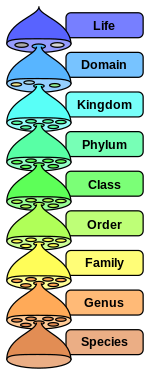 Many academic disciplines make use of the word, taxonomy including: education, business, chemistry, and biology, although the term is not limited to these fields. Emerging from the Latin word meaning to rank or appraise, biologic taxonomy endeavours to make more explicit the relationship of one biological organism to another. There are several approaches by which scientists may do this. The standard rank ordering of plants and animals includes the categories: kingdom, phylum, class, order, family, genus, and species. In the case of haskap, they are a part of the larger kingdom of plants, and narrows down to lonicerea...edible blue honeysuckle - a specific grouping (i.e. a species) which is distinguishable by certain readily recognizable characteristics that are common to any and all of these plants. Furthermore, different varieties exist within this species...Tundra, Borealis, etc..
Subscribe to:
Posts (Atom)